Jesus is Called God in 2 Peter 1:1
12/22/20234 min read
There are some passages in the New Testament wherein Jesus is explicitly called God, and a particularly potent one is from Peter at the beginning of his second letter. In verse 1, the phrase of note is “our God and savior, Jesus Christ.” The noun, “God,” does not here mean the Father, but actually Jesus, just as the Legacy Standard Bible brings out in the quoted translation above (modern translations in general have it this way). But how do we know for sure? There is a grammatical rule in the Greek text which makes it certain that both nouns, “God” and “savior,” are for the named person, Jesus Christ. While attempting the best I can to keep the information simple, I present here a brief exposition of this rule.
This rule of Greek syntax, known as the “Granville Sharp rule” (named after the man who discovered it), says: 1) when multiple singular nouns are joined by the word “and” (“kai” in Greek), 2) the word “the” (called an “article”) precedes the first noun and is not repeated for the other nouns, and 3) the nouns are neither impersonal nor proper names, then it is the case that all nouns refer to one person. Peter’s phrase meets all criteria.
For clarity’s sake, I should say that the article (“the”) does not appear in English before the first noun (God), but it does in Greek. This is normal in that language, but English does not translate it because it would not make sense in English to do so. Also, the Granville Sharp rule still applies even with the presence of other modifiers such as prepositions, prepositional phrases, etc., within the clause.
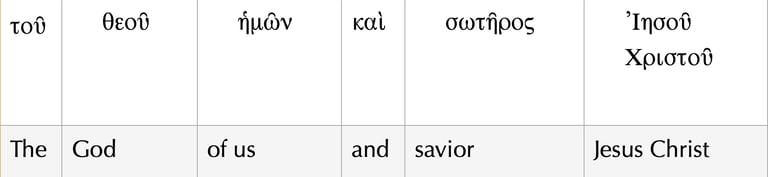
The phrase of 2 Peter 1:1 is as follows:
The obviousness of Jesus being called God in this verse may be a bit obscure to those reading the King James Version wherein the translators in the 1600s rendered the clause as, “God and our Saviour Jesus Christ” (emph. mine - AKR), placing the word “our” before Saviour and not before God. Though they were good Greek scholars, they did not know the implications of the Granville Sharp construction. They can hardly be blamed seeing that the rule would not be discovered until the 18th century.
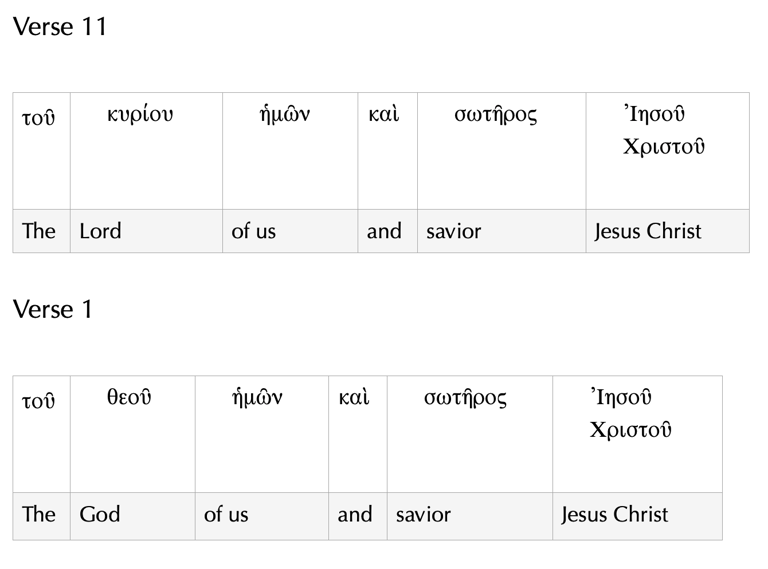
Every occurrence in the New Testament (and there are many) where a phrase appears with all the Granville Sharp criteria met, one person is in view. Perhaps the best example is the nearest one to 2 Peter 1:1, just 10 verses away. In verse 11, Peter says, “For in this way the entrance into the eternal kingdom of our Lord and Savior Jesus Christ will be abundantly supplied to you.” This phrase not only follows the same grammatical pattern but also is nearly word for word like the phrase in verse 1 with the exception of “Lord” for “God.”
Few people would question that both nouns in verse 11, “Lord” and “Savior,” refer to Jesus, but the same construction is found in both verses. So why not be consistent? Evidently because the theology of some would not allow this kind of affirmation of the deity of Christ. The apostle seemingly had no such problem.
I’ll now list a few more biblical examples of the Granville Sharp construction and rule.
HEBREWS 3:1
“Therefore, holy brothers, partakers of a heavenly calling, consider the Apostle and High Priest of our confession—Jesus” …
Jesus is both the “apostle” and “high priest.” Multiple nouns. One person.
PHILIPPIANS 2:25
“But I regarded it necessary to send to you Epaphroditus, my brother and fellow worker and fellow soldier, who is also your messenger and minister to my need”…
There are three nouns in this instance: “Brother,” “fellow worker,” and “fellow soldier,” and per the rule, all apply to Epaphroditus.
MARK 6:3
“Is this man not the carpenter, the son of Mary, and brother of James and Joses and Judas and Simon?”
Sharp’s rule applies to the clause “the son of Mary, and brother of James and Joses and Judas and Simon.” The nouns (excluding their modifiers) are “son” and “brother,” and both refer to “the carpenter.”
These select examples demonstrate the consistency of Sharp’s rule and more could be listed. The deity of Christ is found all throughout the New Testament literature, often implicitly, but also in the plainest of terms, and in 2 Peter 1:1, we have a clear example of the latter—a plainly stated affirmation of Jesus Christ as God.